

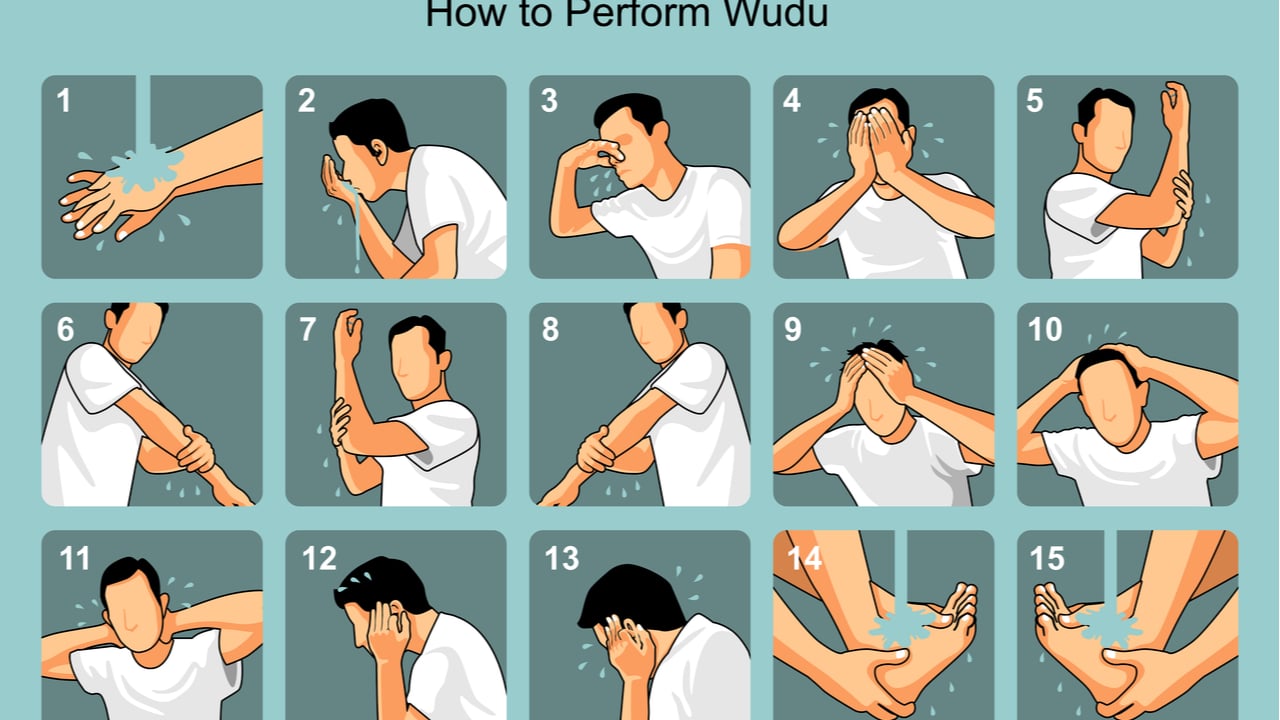
Wudu (ritual ablution) is the sacred act of physical and spiritual purification required before performing daily Salah (prayers), touching the Holy Quran, or circumambulating the Kaaba (Tawaf). The Prophet Muhammad (peace be upon him) said: "Cleanliness is half of faith." (Sahih Muslim), and established that sins are washed away from every limb with the final drops of ablution water. Below is the complete, authentic step-by-step guide on how to perform Wudu according to the Sunnah, including the mandatory pillars, recommended practices, and post-Wudu Duas.
1. The 4 Mandatory (Fard) Pillars of Wudu
In Surah Al-Ma'idah (5:6), the Holy Quran outlines the four non-negotiable components of ablution. If any of these four steps is missed, the Wudu is invalid:
- Washing the Face: From the top of the forehead (hairline) to the bottom of the chin, and from earlobe to earlobe.
- Washing Both Arms: From the fingertips up to and including the elbows.
- Wiping (Masah) the Head: Passing wet hands over the head.
- Washing Both Feet: Up to and including the ankle bones.
2. Complete Step-by-Step Sunnah Method of Wudu
Step 1: Intention (Niyyah) & Saying Bismillah
Formulate a sincere intention in your heart to perform Wudu for the sake of Allah and to purify yourself for prayer. Begin by saying:
Arabic: بِسْمِ اللَّهِ
Transliteration: Bismillah.
Translation: "In the name of Allah."
Step 2: Washing the Hands (3 Times)
Wash both hands up to the wrists thoroughly three times, ensuring water reaches between the fingers (interlacing fingers / Khilal) and under rings.
Step 3: Rinsing the Mouth (Madmadah — 3 Times)
Take a handful of clean water in your right hand, cup it into your mouth, swirl it around thoroughly to cleanse the teeth and gums, and spit it out. Repeat 3 times.
Step 4: Cleansing the Nose (Istinshaq & Istinthar — 3 Times)
Sniff a small amount of water from your right hand into your nostrils, and gently blow it out using your left hand to clear any dust or impurities. Repeat 3 times.
Step 5: Washing the Entire Face (3 Times)
Wash the entire face three times with both hands, from the normal hairline down to the chin and from ear to ear. If you have a thick beard, run wet fingers through the beard hair to ensure moisture reaches the skin.
Step 6: Washing the Arms up to the Elbows (3 Times)
Wash the right arm from the fingertips up to and including the elbow 3 times, ensuring no dry spots remain. Then wash the left arm in the exact same manner 3 times.
Step 7: Wiping the Head (Masah — Once)
Wet your hands with fresh water, shake off the excess, and wipe over your head once: start from the forehead hairline, slide both hands back to the nape of the neck, and then bring them forward back to where you started.
Step 8: Wiping the Ears (Once)
Immediately after wiping the head (using the remaining moisture on your fingers), insert your index fingers into the ear canals to wipe the inner grooves, while using your thumbs to wipe the outer back sides of both ears once.
Step 9: Washing Both Feet up to the Ankles (3 Times)
Wash your right foot thoroughly up to and including the ankle bone three times, using your left pinky finger to clean between each toe. Repeat the process for the left foot three times, paying close attention to the backs of the heels.
3. Authentic Duas to Recite After Completing Wudu
Arabic:
أَشْهَدُ أَنْ لَا إِلَهَ إِلَّا اللَّهُ وَحْدَهُ لَا شَرِيكَ لَهُ، وَأَشْهَدُ أَنَّ مُحَمَّدًا عَبْدُهُ وَرَسُولُهُ،
اللَّهُمَّ اجْعَلْنِي مِنَ التَّوَّابِينَ وَاجْعَلْنِي مِنَ الْمُتَطَهِّرِينَ
Transliteration:
Ash-hadu alla ilaha illallahu wahdahu la shareeka lahu, wa ash-hadu anna Muhammadan 'abduhu wa rasooluh.
Allahummaj-'alni minat-tawwabeena waj-'alni minal-mutatahhireen.
Translation:
"I bear witness that there is no deity worthy of worship except Allah alone without partner, and I bear witness that Muhammad is His servant and Messenger. O Allah, make me among those who constantly repent and make me among those who purify themselves."
Prophetic Virtue: The Prophet ﷺ said that whoever recites this supplication after completing Wudu, all eight gates of Paradise are opened for them to enter through whichever they choose. (Sahih Muslim & Jami' at-Tirmidhi).
4. What Nullifies or Breaks Wudu (Nawaqid al-Wudu)?
Your Wudu remains valid until one of the following occurs:
- Natural Bodily Discharges: Any excretion of urine, stool, or passing of wind/gas.
- Deep Sleep: Heavy sleep where one loses conscious awareness of their surroundings.
- Loss of Consciousness: Fainting, anesthesia, intoxication, or severe illness.
- Direct Contact with Private Parts: Touching the private parts directly with the bare palm/fingers without a barrier.
5. Common Mistakes to Avoid During Wudu
- Wasting Water: The Prophet ﷺ cautioned against using excessive water even when performing Wudu beside a flowing river. Turn the tap down to a gentle stream.
- Leaving Dry Patches: The Prophet ﷺ once noticed dry heels on some companions and warned: "Woe to the heels from the Fire!" (Sahih al-Bukhari). Ensure water covers every millimeter of the arms, elbows, and ankles.
- Innovated Duas for Each Limb: There are no authentic Sahih Hadiths prescribing specific separate Duas for washing the face, right arm, or feet. Say Bismillah at the start and recite the Shahadah after finishing.
Frequently Asked Questions (FAQ)
1. Is it permissible to wipe over leather or thick socks (Masah)?
Yes. If you performed a complete Wudu (including washing the feet) before putting on clean, thick socks or leather footgear (Khuffayn), you may simply wipe over the top of the socks with wet hands during subsequent Wudus for up to 24 hours (for residents) or 72 hours (for travelers).
2. Does bleeding break Wudu?
According to the Shafi'i and Hanbali schools of thought, minor surface bleeding from a paper cut or scrape does not break Wudu. According to the Hanafi school, heavy blood flowing beyond the wound site nullifies Wudu.
3. Do I need to redo Wudu if I change my clothes?
No. Changing clothes, cutting hair, or trimming fingernails does not break an existing valid Wudu.
May Allah (SWT) accept our purification, grant us sincerity in worship, and make us among those who are beloved to Him for their cleanliness and repentance. Ameen!
