

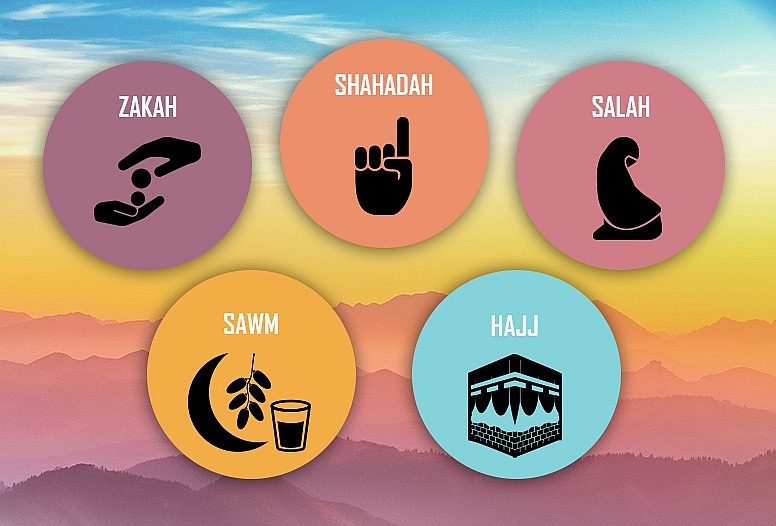
The Five Pillars of Islam (Arkan al-Islam) represent the foundational obligations and spiritual bedrock upon which every Muslim builds their religious life and ethical character. The Prophet Muhammad (peace be upon him) summarized this structure in a famous narration: "Islam is built upon five [pillars]: testifying that there is no god but Allah and that Muhammad is the Messenger of Allah, establishing regular prayer, paying Zakat, performing Hajj to the House, and fasting during Ramadan." (Sahih al-Bukhari 8, Sahih Muslim 16). Below is an in-depth, structured guide to each of the five pillars, their spiritual significance, and how they shape the daily life of over two billion Muslims worldwide.
1. The Five Pillars at a Glance
| Pillar | Arabic Name | Core Purpose & Frequency |
|---|---|---|
| 1. Declaration of Faith | Shahadah (الشهادة) | Affirming the absolute Oneness of Allah (Tawhid) and the final Messengership of Prophet Muhammad ﷺ. Continuous lifetime conviction. |
| 2. Obligatory Prayer | Salah (الصلاة) | Direct spiritual communication and prostration before Allah performed five times daily. |
| 3. Compulsory Charity | Zakat (الزكاة) | Purifying wealth by giving 2.5% of annual qualifying savings to the poor and needy once every lunar year. |
| 4. Fasting Ramadan | Sawm (الصوم) | Abstaining from food, drink, and desires from dawn to sunset during the 9th lunar month to cultivate God-consciousness (Taqwa). |
| 5. Holy Pilgrimage | Hajj (الحج) | Pilgrimage to Makkah in Dhul-Hijjah once in a lifetime for those physically and financially able. |
2. Detailed Breakdown of the Five Pillars
Pillar 1: Shahadah (The Testimony of Faith)
The Shahadah is the entry point into Islam and the cornerstone of all Islamic belief. It consists of two essential declarations:
Arabic:
أَشْهَدُ أَنْ لَا إِلَهَ إِلَّا اللَّهُ، وَأَشْهَدُ أَنَّ مُحَمَّدًا رَسُولُ اللَّهِ
Transliteration:
Ash-hadu alla ilaha illallahu, wa ash-hadu anna Muhammadan rasoolullah.
Translation:
"I bear witness that there is no deity worthy of worship except Allah, and I bear witness that Muhammad is the Messenger of Allah."
Pillar 2: Salah (The 5 Daily Prayers)
Salah serves as the believer's direct, unmediated lifeline with Allah, establishing discipline and mindfulness throughout the day:
| Prayer Name | Time of Day | Obligatory Units (Fard Rak'ahs) |
|---|---|---|
| Fajr | Before sunrise (Dawn) | 2 Rak'ahs |
| Dhuhr | Just after solar noon (Midday) | 4 Rak'ahs |
| Asr | Late afternoon | 4 Rak'ahs |
| Maghrib | Immediately after sunset | 3 Rak'ahs |
| Isha | Nightfall | 4 Rak'ahs |
Pillar 3: Zakat (The Obligatory Almsgiving)
Zakat is not voluntary charity (Sadaqah); it is a calculated financial right of the poor upon the rich (Surah At-Tawbah 9:60):
- The Nisab Threshold: Payable only by Muslims whose net wealth exceeds the cash value of 85 grams of gold or 595 grams of silver for one lunar year.
- The Rate: Exactly 2.5% of net liquid savings, business inventory, and gold/silver assets.
- Socioeconomic Goal: Eliminates systemic poverty, curbs greed, and ensures wealth circulates throughout the entire community.
Pillar 4: Sawm (Fasting During the Month of Ramadan)
Observed throughout the ninth month of the Islamic calendar, fasting from the break of dawn until sunset trains the human ego in self-control and empathy:
- Physical Restraint: Total abstinence from food, drink, smoking, and sexual relations during daylight hours.
- Moral Discipline: Refraining from anger, lying, backbiting, and arguments.
- Exemptions with Mercy: The sick, elderly, travelers, pregnant, nursing, and menstruating women are exempt, with options to make up missed days later or feed the poor (Fidya).
Pillar 5: Hajj (The Pilgrimage to Makkah)
Hajj is the grand annual gathering in Makkah during the 12th Islamic month (Dhul-Hijjah), obligatory once in a lifetime for those with physical and financial capability (Istita'ah):
- Universal Human Equality: Over two million pilgrims from every nation wear identical seamless white cloth (Ihram), completely erasing distinctions of race, nationality, wealth, and status.
- Sacred Rites: Circumambulating the Kaaba (Tawaf), standing on the Plain of Arafat in supplication, and remembering the legacy of Prophet Ibrahim (AS).
3. The Difference Between the 5 Pillars of Islam & the 6 Articles of Iman
- The 5 Pillars of Islam: The outward, physical, and practical actions of worship (Shahadah, Salah, Zakat, Sawm, Hajj).
- The 6 Articles of Iman (Faith): The inward, spiritual beliefs of the heart (Belief in Allah, His Angels, His Revealed Books, His Messengers, the Day of Judgment, and Divine Decree / Qadr).
Frequently Asked Questions (FAQ)
1. Can someone become a Muslim by simply saying the Shahadah?
Yes. Sincerely reciting the Shahadah with belief in the heart and understanding its meaning in front of witnesses makes an individual a Muslim, after which they begin learning and implementing the other four pillars.
2. What happens if someone cannot perform Hajj due to financial or physical limitations?
If an individual genuinely lacks the financial means or physical health to travel to Makkah, they are completely excused from Hajj, and there is no sin or deficiency on their record, as Allah only obligates it on those who possess the ability (Surah Ali 'Imran 3:97).
The Five Pillars of Islam provide a complete, balanced framework that harmonizes faith, physical devotion, financial generosity, and global brotherhood. May Allah (SWT) keep us firm on the straight path!
